


For all teams across England, while their goal may just be to do well in whichever league they are currently in, it must remain true (at least in some sense) that the ultimate goal is to make the Premier League and be competitive in the Premier League. But before you can make it to the Premier League, you must conquer the Championship. And recently I’ve thought, what is the best way to get out of the Championship and be competitive in the ensuing Premier League season?
Sure, it makes logical sense to aim to win the Championship because, in theory, you would be the best team you could possibly be outside of the Premier League and thus be in a better position to compete once you get there. But that isn’t always true. We’ve seen many Championship winners come up and go down just as quickly. In fact some of the least competitive teams in the Premier League have been teams that won the Championship the season before.
This prompted me to inquire into whether it’s actually worth it to win the Championship if you want to be competitive in the Premier League. This may sound insane at first but at the end of this article it will be clearer as to why this is more of a debate than it appears to be at face value.
My hypothesis
In short, my wild theory, and the stance I took before doing any research, was that teams aiming to be competitive in the Premier League ought to be ‘Premier League-ready’ instead of ‘Championship-ready’. And by this I just mean that teams in the Championship should build their squads with a view to the Premier League so that, if/when they make it there, they are already well equipped to be somewhat competitive and potentially survive in the league long term.

The early part of this Premier League season acted as inspiration for this idea as Hull City, the team who came sixth in the Championship last year and won the playoffs, look like the best of the three promoted sides this season. They have beaten Manchester United and Coventry, secured draws away at Chelsea and Newcastle, and held Aston Villa to a 0-0 draw at home too. This is all the more baffling when you consider that Hull City finished 21st in the Championship two seasons ago and only avoided relegation by way of goal difference. Whereas Coventry City just won the Championship last season by the biggest margin (11 points) that we’ve seen in the last 15 years. And Ipswich Town were in the Premier League just two seasons ago and have come straight back up as last season’s Championship runners-up.
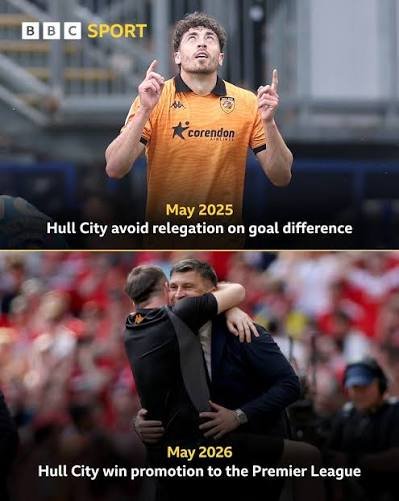
So how is it that a team that was just one point away from being relegated to League One can win the Championship playoffs the very next season, and then be competitive in the Premier League the season after? I argue that it’s because being good in the Premier League and being good in the Championship are two completely different things.
Last season Hull City finished the Championship with a +4 goal difference, which was miles away from Coventry’s +52 and Ipswich’s +33. Coventry and Ipswich lost 15 games combined and Hull lost 15 on their own. That tells us is that Hull weren’t particularly impressive in the Championship, whereas Coventry and Ipswich certainly were. Hull’s identity last year was clearly quite pragmatic, which is evidenced by their average possession being just 45.7%. Compare this with the two teams that were the most impressive in the Championship last season, Coventry sat at 55.2% and Ipswich at 56.1%.
Now this season Hull have had a meagre 32.3% possession but with the ability that they showed last season to get results regardless of having a lower share of the ball, they’ve been able to translate their style of play to the Premier League a lot easier than the other two promotees. Coventry, for example, have had just 39% possession this season, a far cry from the 55.2% that they had last year. Because of the massive shift in their style of play and the way that they have to approach games in the Premier League compared to the Championship, they have lost four of their first five games, conceding ten and scoring just one goal. Ipswich have had a much better time translating their possession-heavy game from the Championship into the Premier League, but they still sit at 44.8% possession and have won two and lost three in their first five games.
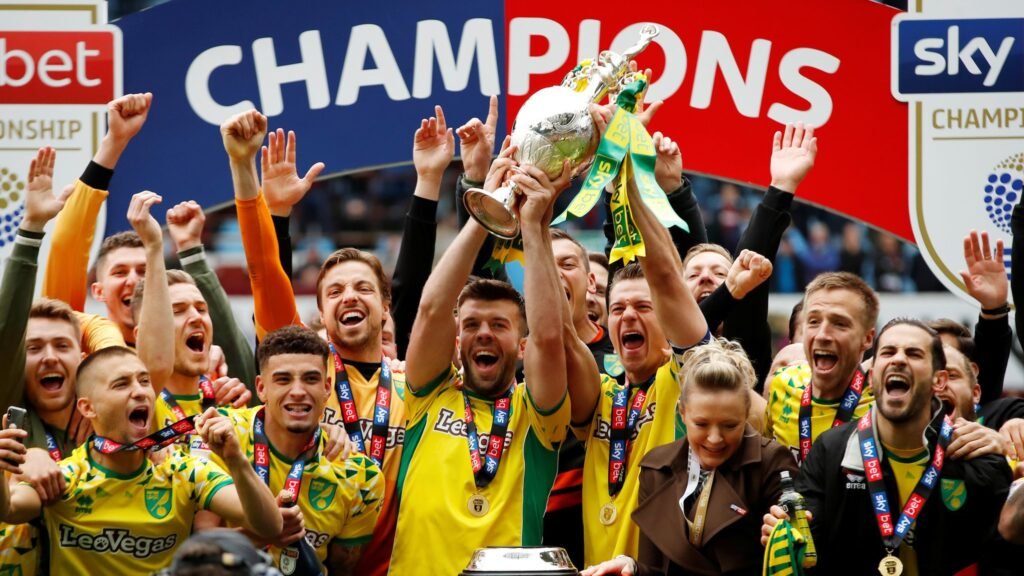

As a Norwich native, I’ve seen two first-hand examples of this on my front doorstep. Norwich were promoted to the Premier League by way of winning the Championship in both 2018-19 and 2020-21 and finished plum last in the ensuing seasons – meaning that both of the other sets of promotees fared better than them. In both of their Championship title-winning seasons, Norwich were truly dominant, winning with 94 and 97 points respectively. Yet they managed to muster up only 43 points and a -110 goal difference across two follow-up Premier League campaigns.
The thing about being really good in the Championship is that you can be dominant and control games with a level of quality that just won’t cut it in the Premier League. Vincent Kompany’s Burnley in 2022 and the two Norwich examples that I’ve already mentioned played a style of football that, in the Championship, was totally breathtaking but those players weren’t of high enough quality to be able to play that same style of football in the Premier League.
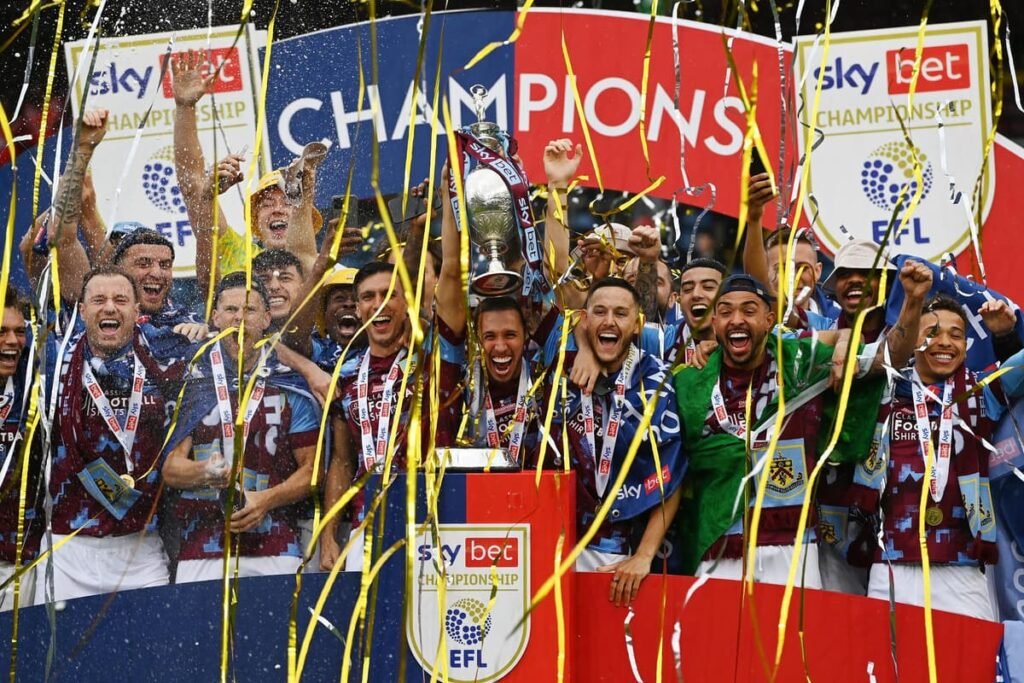
And for those of you who remember just how much noise surrounded that Burnley side in the 2022/23 season, you will know that their Premier League performance compared to their Championship one was fascinating. Under a young, forward-thinking Vincent Kompany, Burnley won the Championship with 101 points, 87 goals scored, and averaged 64.7% possession playing some of the best football the Championship had seen in recent years. In the Premier League, Kompany remained committed to his philosophy, and believed that his system was potent enough to mask over the lack of quality that his team had compared to the rest of the league. He turned out to be very, very wrong and almost every week we were seeing a multitude of mistakes leading to goals due in large part to Kompany’s commitment to the style of play that was so successful against inferior Championship competition. They finished the season in 19th, winning just 5 games, and a -37 goal difference. Luton Town, the playoff winner that season, finished with two more points, and 11 more goals scored than Burnley, playing a less complex route-one style of football. Bear in mind that in the Championship, Luton earned 21 fewer points and scored 30 fewer goals.
That is something that almost no one would have predicted before the season but maybe we should have seen it coming. Typically, promoted teams have to play much more defensively and pragmatically in order to get results because their squads simply aren’t talented enough to go toe to toe with those in the Premier League. But when you build a squad to be dominant in the Championship and then need to play a totally different style of football once you’re promoted to the Premier League, you often don’t have the manager or squad capable of actually playing that style to a level that will allow you to survive or be competitive.
Obviously there is a big elephant in this room, and that’s the fact that you can’t really hedge your bets on winning the playoffs. And as much as I would love to say that ‘based on the numbers, teams shouldn’t even bother with automatic promotion and just should just build with an look at the playoffs’, that just wouldn’t make sense. You cannot quantify the feeling of the playoffs and you sure cannot predict the winner. Since 2010/11, the 3rd place finisher in the Championship has only gone on to win the playoffs 6 times – just 38% of the time. That’s just as often as the team in 4th place has won it.
So, whilst it may not be advisable to think that the best route to sustained Premier League success is through the playoffs, if you’re not a team that can realistically aim at automatic promotion, there is definitely still a route to such success. And in some ways, it may actually be a better one.
Regardless, there is clearly something to be said about the value of dominating the Championship as it pertains to future Premier League competitiveness, so I looked deeper at the numbers to try and figure out what on earth is going on.
How did the last 15 sets of promotees do in their ensuing PL seasons?
In the spirit of both your time and mine, I only travelled 15 years back in time to look at how the most recent promotees have fared in their first Premier League seasons, and the following graph shows just that.
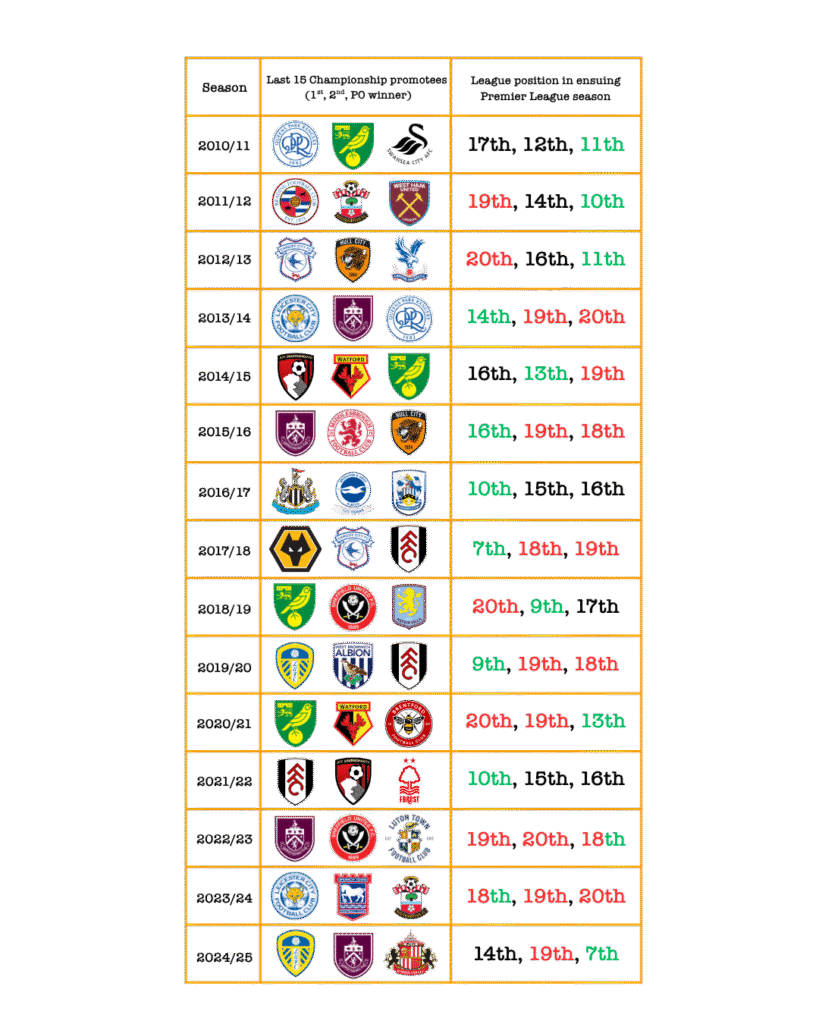
In those 15 seasons, the following was true:
Relegation
- The Championship winner was relegated 6 times.
- The Championship runner-up was relegated 8 times.
- The Playoff winner were relegated 7 times.
So as it pertains to surviving the first season, those who won the Championship did the best here, followed by those who won the playoffs, and then the runners-up actually went back down in there first season more often than they stayed up. That may be surprising as you would assume that a team who secured automatic promotion would be better, overall, than one that qualified for the playoffs, and thus would be better equipped to survive the Premier League season.
Best finishes
Following on, the highest overall finish was 7th by both 17/18 league winners Wolves and 24/25 playoff winners Sunderland. Furthermore:
- The Championship winners had the best season of the three 7 times.
- The Championship runner-up had the best season of the three just 2 times.
- The Playoff winner had the best season of the three 6 times.
The best initial seasons being from a league winner and a playoff winner was remarkable to learn as you would never imagine, before any Premier League season, that a team who won the playoffs could finish anywhere near as high as 7th, but Sunderland’s showing last year was truly remarkable. The share of best finishes is also interesting as the playoff winner was almost as capable of being the best of the promoted teams as the Championship winner. Again, the second-placed promotee was been left in the dust on this metric.
Average finishes
- The Championship winner had an average finishing position of 15.2.
- The Championship runner-up had an average finishing position of 16.4.
- The Playoff winner had an average finishing position of 15.5.
As for the average positions, the stats say that the Championship runner-up is again the least desirable position to be in as a promoted side. Those who’ve come up as runners-up have finished, on average, almost a full position lower than the playoff winner – baffling.
Median finishes
- The Championship winner had a median finishing position of 16th.
- The Championship runner-up had a median finishing position of 18th.
- The Playoff winner had a median finishing position of 17th.
The median finishes just allow for any outliers to not totally skew the stats used as the averages over a 15-year period can be impacted heavily by one or two extreme seasons. But still, the numbers here tell the same story as the others – historically, winning the Championship gives you the best chance to be competitive in the Premier League, followed by winning the playoffs, and then finishing runner-up.
Modal finishes
- The most common finish for the Championship winner was 20th (3 times).
- The most common finish for the Championship runner-up was 19th (6 times).
- The most common finish for the Playoff winner was 18th (3 times).
The modal (most common) finishes however, paint a picture that closely follows the feeling that dominant Championship winners have a propensity to be totally uncompetitive when they embark on the Premier League. Those 3 20th place finishes were from Cardiff in 2013/14, who won the Championship by 8 points with a +27 GD, Norwich in 2019/20, who won the league by 5 points with a +36 GD, and Norwich again in 2021/22 who won the league by 6 points with a +39 GD. By comparison, the Championship runner-up only finished 20th once in those 15 years, and the playoff winner only had 2 last place finishes – puzzling.
What do these numbers tell us?
The numbers here are fairly interesting. First of all it’s still mostly true that if you’re the best team in the Championship, you will have the best chance of surviving and being competitive in the Premier League. However sometimes, as a team that is so dominant in the Championship, your style of play (as was the case for Cardiff and Norwich) doesn’t translate very well to the Premier League, which could leave you totally uncompetitive.
And this may explain why the runners-up in the Championship fare so poorly when they get to the Premier League. That’s because they haven’t quite mastered how to play Championship football, at least not to a level that could allow them to win the league. This means they aren’t even the best team playing Championship-style football, and therefore are even less equipped to transition to Premier League football than even the league winners since they’re just not as good.
But what the numbers do confirm is that teams that make it to the Premier League via the playoffs have a unique opportunity to be competitive. And that’s because they are already not one of the best or most dominant teams at Championship-style football and are often more pragmatic. This means they are already more accustomed to the way that promoted teams have to play in the Premier League anyway, which means they are better equipped than the runners-up and, in some cases, even the Championship winner, to be competitive in the Premier League.
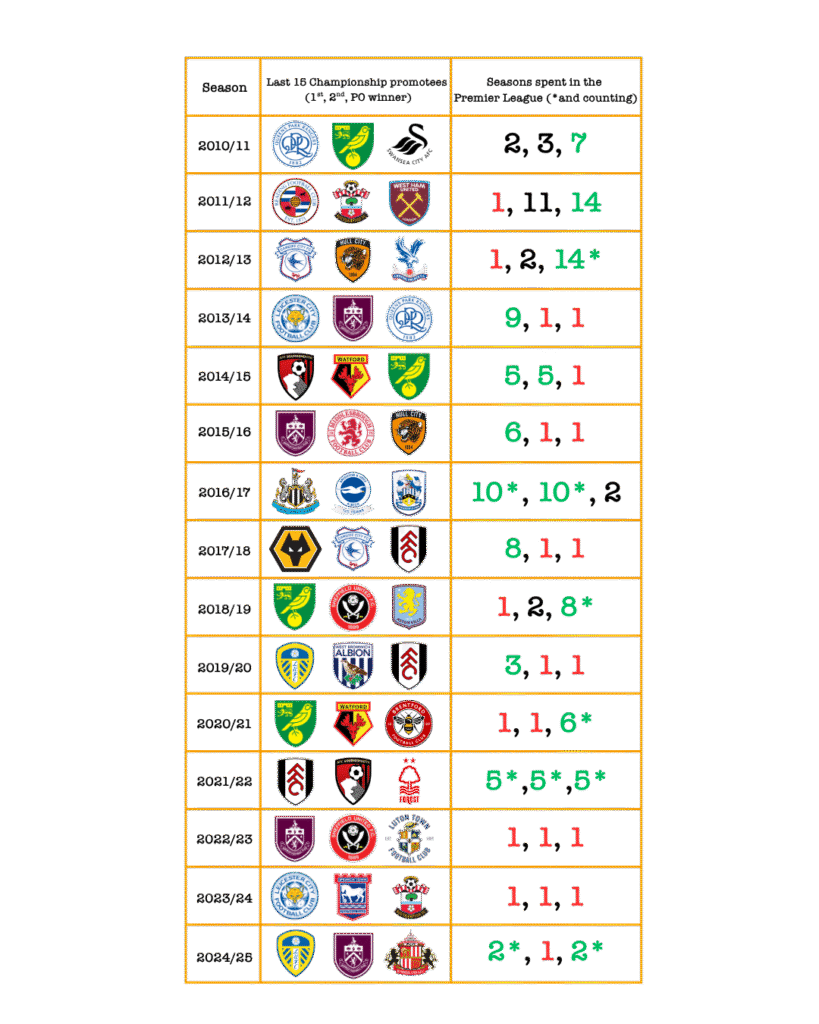
How long did the promotees last in the PL?
But teams don’t just want to be in the Premier League for just two or three seasons, they want to become a fixture. So, I had a look at how long teams have maintained their position in the league after being promoted.
Longest Stint
The longest stint in the Premier League is 14 seasons, held by both West Ham and Crystal Palace. If Palace were to stay up this season, their inclusion in the 2027/28 season would set the record at 15 for this group. Curiously, West Ham and Palace both initially earned promotion to the Premier League by winning the playoffs.
Average Stint
- The average stint in the Premier League for the Championship winner is 3.7 seasons.
- The average stint in the Premier League for the Championship runner-up is 3.1 seasons.
- The average stint in the Premier League for the playoff winner is 4.3 seasons.
This is maybe the most intriguing statistic of them all. Teams that were promoted via winning the playoffs enjoyed a longer average stint in the Premier League than both the group of league winners and runners-up. The idea that team who come through the playoffs being better suited to the style of football they will have to endure as they acclimatise to the level of the Premier League is definitely one that these stats support. And it makes logical sense – if there is no massive change in your style of play, you may not set the league on fire, but you may be able to scrape together results that allow you to be somewhat competitive and remain a Premier League team for an extended period of time.
Median Stint
- The median stint in the Premier League for the Championship winner was 2 seasons.
- The median stint in the Premier League for the Championship runner-up was 1 season.
- The median stint in the Premier League for the playoff winner was 2 seasons.
Modal Stint
- The modal stint in the Premier League for the Championship winner was 1 season.
- The modal stint in the Premier League for the Championship runner-up was 1 season.
- The modal stint in the Premier League for the playoff winner was 1 season.
It is still more common for a promoted team to last just one season in the Premier League than it is for them to have any other length stint in the league.
What do these numbers tell us?
Now these numbers are even more shocking than the regarding the season after promotion because they say that, over the last 15 seasons, the route to the Premier League that will ensure you have the longest stint there is actually through winning the playoffs. But when you think about what the philosophy of a playoff-winning team is compared to a league winner or league runner-up, it maybe isn’t actually that shocking.
A playoff team, or playoff-winning team, is used to not being the best team in the league. They’re used to playing games in which they don’t have control and playing against teams that are more talented than them. For them to still be able to win or finish in the top six of the championship and then win the playoffs, they must have gotten really good at generating results from situations that aren’t totally in their favour.
And when you think about a promoted team in the Premier League, that quality is what keeps many of them up. More often than not promoted teams don’t have breakout Premier League seasons. Of all 45 promoted teams I researched for this article, only 5 of them finished in the top half in their first season. And given that we saw the average finishing position for those teams was around 15th or 16th position, being able to grind out results from games where the odds are stacked against you is a quality that is very important when trying to prolong your stay in the Premier League.
The best way to win the Championship (if you must)
As I’ve established, it may not be worth it for a team to go all out to win the Championship because the transition from Championship football to Premier League football might be too much for a club to do in one season. However, there have been some teams who won the Championship and were so impressive there that they were able to translate that style of football over to the Premier League quite efficiently. And those teams were Wolves in 2017/18 and Leeds in 2019/20.

In the case of Wolves they had just had a massive influx of investment and were able to build a team that had no business being in the Championship and, truthfully, were of a Premier League calibre before they had even played a game in the Premier League. Players like Ruben Neves, Diogo Jota, Matt Doherty, and Willy Boly were all good enough to be mid-table Premier League starters and they showed that once they did make it to the Premier League. Wolves didn’t have to change too much stylistically because they were actually capable of playing that style of football in the Premier League whilst in the Championship. And therefore, they finished their ensuing Premier League season 7th.

As for Leeds they were blessed with one of the best footballing minds the Championship has likely ever seen in Marcelo Bielsa. Even when Leeds made it to the Premier League, he was still one of the best footballing minds there too. This meant that the transition that Leeds had to make from the Championship to the Premier League wasn’t too drastic because they had a manager capable of setting his team up to be competitive there too. This led to them finishing 9th in their first season back in the Premier League since 2004.
So, for teams that are trying to make it to the Premier League and trying to conquer the Championship first; if they can assemble a team that is just so dominant in the Championship that their ensuing Premier League play will roughly take the same shape as their Championship play did, then building a squad to win the Championship is a pretty surefire way of being competitive in the Premier League in the long term.
Conclusion
In conclusion, if this investigation has confirmed just one thing for me, it’s that how well you do in the Championship is absolutely not a reliable indicator of how well you will do in the Premier League. You could be like Norwich, dominating the Championship in one season and then be the worst team in the Premier League the very next. Or you could be like Sunderland and finish 24 points off the Championship lead, make the Premier League only by winning the playoffs, and mange to qualify for Europa League football after finishing 7th in your first Premier League season.
It does seem clear, however, that finishing second in the Championship sets you up the least to be competitive in the Premier League. I argue that this is because if you’re second in the Championship you’re the second-best in a league and environment that isn’t very similar to the Premier League. This means you’re almost playing catch-up for one style of play, you haven’t really mastered it, and now you have to try and master another, very different style in just one season. It’s that difficulty in managing the transition that has left teams that have finished second in the Championship with the worst metrics across the board in their ensuing Premier League season(s).
The playoff winners have a unique opportunity, depending on how they played in their championship season, to be well positioned to adapt to the Premier League. And this is because if you aren’t totally dominant in the Championship, there will be instances in which you have to set up more pragmatically and try and grind out results. This is very similar to the way that promoted teams play the majority of their Premier League games, which means the transition from one league to the other can be far less drastic. This is what I argue has led to the fact that the playoff winners over the last 15 years have had the longest average stint in the Premier League.
And for the league winners it seems to be true that you can win the Championship convincingly, playing a style of football that is completely unsustainable in the Premier League. That is because the calibre of player needed to continue playing that way is often totally inaccessible to a newly promoted side. But if you can amass a squad that is capable of competing in the Premier League as currently constructed or with maybe a few minor tweaks (like Wolves and Leeds were able to), then aiming to win the Championship is still the best way for a team to reach the Premier League and stay there.
There’s definitely an argument to be made for Championship sides to think ahead to the Premier League, try to build a squad and system around the way they will have to play once they get there. But of course, the security of automatic promotion is something that cannot be overlooked. After all, you cannot guarantee, however good you are, that you will come out of the playoffs victorious – and spending another season in the Championship is absolutely not the goal. So, there’s a fine line that sits between being ‘Championship good’ and ‘Premier League good’. Teams must find a way to be just ‘Championship good’ enough that they can actually make it to the top flight, but then also think about being ‘Premier League good’ so that they can actually stay there.
An extra piece of advice that I’m not sure is comedic or actually worth taking: no matter what… DO NOT FINISH SECOND. The numbers will always be against you even if logic isn’t.






How The Athletic are consistently ‘ahead of the curve’