


When you think of the virtues that we as humans would want to embody, being confident and analytical would likely rank pretty highly for most people (and even more so for sportspeople). And, on face value, it does seems as though someone who is very analytical in their life, can also be one that carries themselves with a lot of confidence. So, if it’s that simple, then what is the point of this article? And what does it have to do with sports?
Well, in my experience, the having of one can often limit one’s ability to have the other – at least in the instances in which one of the two virtues is active. What I mean by that is, more often than not, supreme confidence limits one’s ability to be clearly and reasonably analytical. And on the flip side, when one is being led primarily by a desire to be analytical, their level(s) of confidence tends to suffer.
Quick note: whilst personal experience gives me some reasoning to believe that my hypothesis is correct, I still have to show that those experiences can be generalised. And that’s what makes this different from a mere opinion piece – by the end of this article I hope it is clear just how general the link between analysis and confidence is.
It’s harder to ascertain how much having confidence limits your analytical potential – and that’s because very confident people tend to analyse sub-consciously in a sort of ‘flow state’. Meaning that they are so engrossed in whatever activity they are performing that analysis is almost sub-conscious and thus one cannot tell just how much better or worse they are at it or how much more or less analysing they are doing. This is the kind of confidence and analysis combination you typically find in elite athletes.
But then there is also a blissful level of confidence that some reach where they don’t analyse at all because they are so set in their ways and believe wholeheartedly that they will be successful regardless of changing external factors. This kind of confidence and analysis combination that you find in social situations and is often interrelated to people’s core personality traits. More informally, these are the people you find insufferably self-righteous…
Looking at how high confidence affects one’s ability to be analytical is definitely something worth delving into, but today I just want to tackle this:
What happens to confidence when you’re overly analytical? And is it possible that being too analytical can be a factor in low confidence?
What is an analytical mind?
An analytical mind, for the sake of this essay, will refer to one that aims to find many solutions to a problem, and from there then discerns which is the best for a given situation. Now it may feel as though everyone has an ‘analytical mind’ if that is the description, but this kind of analysis is not always required for us to complete the majority of our tasks, and thus we need not analyse in this way.
As it pertains to sport, being analytical in this way is not strictly necessary; and in many ways, a lack of analysis will help one’s performance. This is an idea that Eden Hazard spoke about when Thierry Henry asked about his elite dribbling abilities. When asked what cues he looks for and what makes him so good at dribbling, Hazard said ‘I don’t think… it’s all instinct’. Henry by contrast said that he is ‘always looking [at the defender’s feet]’ when dribbling to analyse where he should attack him. So here, Henry is an example of a sportsperson with an analytical mind. He is discerning, in the moment, which solution will best solve his problem – that being how to dribble past his defender.
So, how does the analytical mind limit confidence?
Well the thing about good analysis is that by the end of it, you have a good idea of all the possibilities, all the good outcomes, but also all the bad outcomes.
So, imagine now that you are a basketball player that is an elite shooter. The best shooters understand exactly how they should shoot a basketball, and how bad mechanics causes bad shooting. Every good shooter has gone through the process of missing left and right and long and short, and the very best understand why all of those misses happen, and how to fix them. Maybe they understand where their base and balance lacks sturdiness, or maybe they understand the importance of a high arc, or maybe they just know that their shot requires a firm and extended flick of the wrist. In a sense, that level of analysis is what gives them confidence in their ability to shoot well… because they know how not to miss in those specific ways.
However, being aware of all the different ways that their shot could be compromised is sure to cast some doubt over their confidence that they will consistently make shots. If you know that there is so much that goes into the perfect jump shot, and on any attempt, you could miss because of one seemingly small misstep, you’re bound to be less confident than someone who is blissful in their ignorance of all of those little details. When people say ignorance is bliss, they typically use it in reference to one’s ability to live confidently in themselves because they know no better. In sport, we see that idea in practice. Without an analytical mind, you have less obstacles in the way of true confidence. With one, you are fighting all the ways that you have identified that you can fail, and still trying to have faith that you won’t.
This is what may be plaguing Florian Wirtz at Liverpool and could explain why he has such massive fluctuations in performance between his club and national team. Wirtz has always been an improviser, it is what made him such a special talent at Bayer Leverkusen, and why so many football fans fell in love with his game. The improvisers are the special talents (at least visually), whilst those who are basic and effective (i.e. Busquests and Rodri) are often underappreciated.
Well, Wirtz in a Liverpool shirt looks to have lost almost all of his improvisation, and has resorted to a more mundane and safe style of play. He has a tendency to make mistakes (like any attacking midfielder), but they seem to weigh on his mind and future decision making far more than they would for other improvisers like Cole Palmer. When Palmer makes mistakes, he shrugs them off and attempts an even more audacious action next time – and he has been notorious for saying that he, just like Hazard, plays football on autopilot.
Wirtz has not been like that for Liverpool. He has been taking fewer risks than he did when he was at Leverkusen. That may be down him wanting to limit mistakes and thus he seems to be tapping into his analytical mind. The thing with being analytical though, is that it can zap you of your ability to make decisions quickly since you’re weighing up so many potential solutions; and is problematic for Wirtz as creative midfielders must be able to make decisions quickly in order to exploit defenses.



In this example, Wirtz has an opportunity to play a through ball to Milos Kerkez but he takes so long to make the decision to pass the ball that the angle is no longer advantageous and he ends up playing it straight out of play. A confident and improvising Wirtz plays the pass much earlier with no prolonged analysing period.
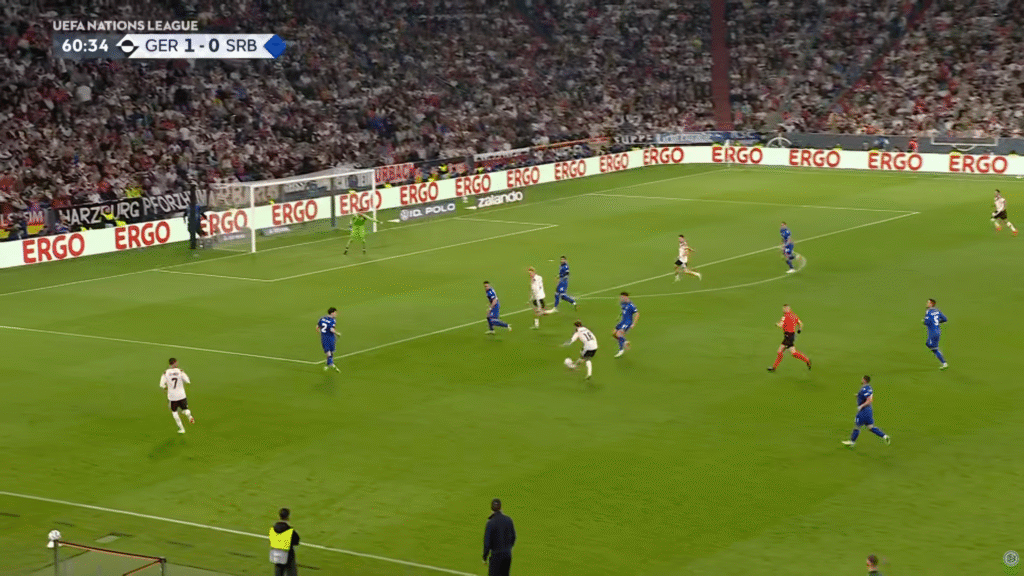
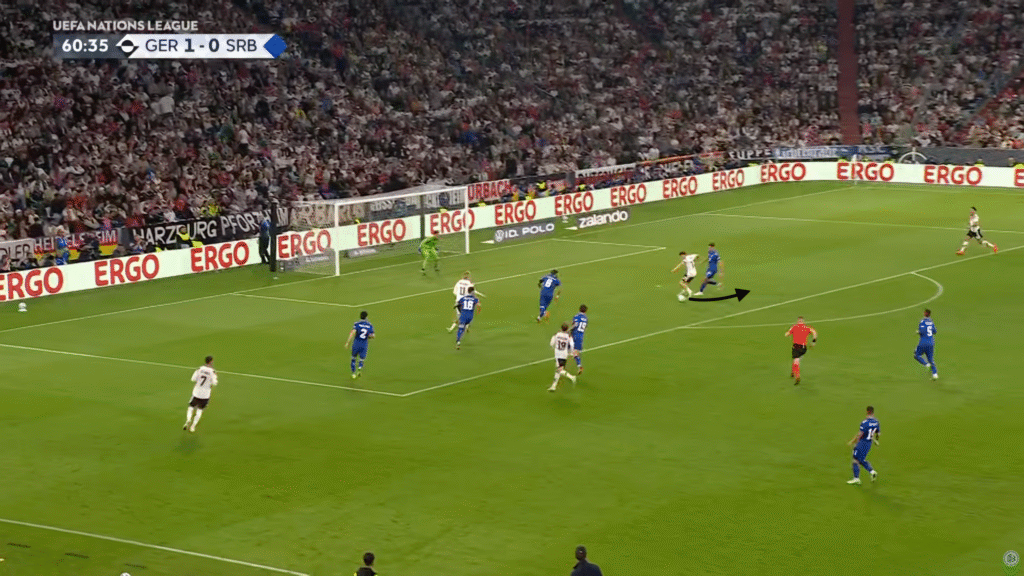
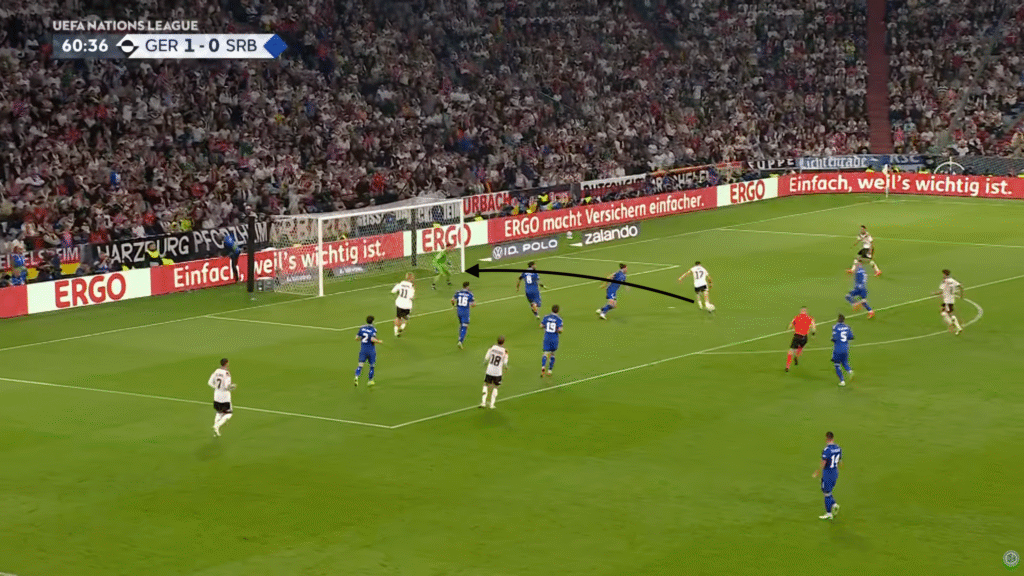
Here for Germany, Wirtz’ first touch is unbelievably good. But more importantly, it is instinctive and it takes him away from the defender alongside him. His finish is also a quick one, with no deliberation about how or where to place it. This is what makes Wirtz special.
When you add the context that Wirtz is one of the most scrutinised players in world football right now, it would not be implausible to assume that the reason he is taking fewer risks is because he is being over-analytical (in an attempt to limit his mistakes) and thus unable to make decisions quickly enough to take advantage of defenses.
And the worst part of the effects of over-analysis on confidence is that they can very quickly snowball out of control. Let’s say you have made a few mistakes, you might be convinced that you just need to think a little more when making your next action. But by thinking too much, you make another mistake because you took too long to decide. So, you’re further convinced that you just need to think a little harder next time to make a quicker decision. But that leads you to make another slow decision because you’re not confident in what you’re seeing. This process, in theory, can go on for eternity and at a point you just begin to take the quickest and safest possible options you can as you have no confidence in your ability to analyse information quickly. This is what seems to be happening to Florian Wirtz, and as a midfielder myself (albeit 7 divisions below Wirtz), I have experienced exactly what it looks like he is experiencing now.
Thus, it seems clear to me that the analytical mind limits confidence, not by making you directly less confident in your abilities, but by making you more aware of all the ways that you could fail in spite of them. For the basketball player with an analytical mind, they need not feel like they will miss their next shot just because they know that there are so many different ways to cause a miss, but the mere fact that they know how many different ways they could miss is bound to put a cap on their confidence. At least when compared to someone without an ‘analytical mind’.






xPass and PAx – the future of passing analytics?