
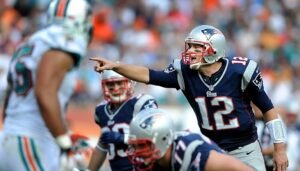

With the NFL season now underway, I’ve been back in love with the intricacies of football. And after years of studying passing concepts, diagnosing rolling coverages, and trying to understand formations and personnel, I can now write this article with the utmost confidence. Playing quarterback has to be the most impossible job in all of professional sports.
Now let me preface this with the obvious – I haven’t played every sport, so I may not truly understand how difficult it is to be a hockey goalie. However, from the research I have done into the positions that are regularly deemed to be the hardest to play in pro sports (i.e hockey goalie, cornerback, soccer goalie, baseball catcher etc.) I just don’t see how any of them can hold a candle to what it takes to be a good quarterback. And before I continue, for those that do consider the most difficult positions in sports, there is never a mention of central midfield in football (soccer). As someone who plays this position at just a semi-professional level, the idea that being a goalkeeper is more difficult is just unfathomable. But anyway, that lends support to the idea that these kinds of debates are naturally subjective, and my claim that quarterback is the most difficult is one that you can feel free to dispute. After all, my main goal here is to shed light on just how much goes into playing the position as opposed to convincing you to join me as a quarterback sympathiser.
The Physical Gauntlet
For anyone (like myself) who didn’t grow up throwing a football around in the garden, at school with their friends, or playing games on the weekend, throwing a football with a perfect spiral is very difficult. More often than not, if a quarterback doesn’t throw the ball with a pretty spiral, their pass simply doesn’t get to where it needs to on time – and timing is everything as a quarterback. Half a second late and your window to fit a pass might’ve just closed and now you’re either getting sacked by 300lbs men or throwing an interception.
But imagine you’ve got the mechanics down and you can consistently throw a perfect spiral, you also need to possess elite arm strength. Without it, you will struggle to fit passes through tight windows and again, will struggle to deliver the ball on time to your targets.
Okay great, you can throw pretty and you can throw hard, but now you have to do that while dodging 300lbs defensive linemen that are literally paid millions of dollars every year to throw you to the floor as quickly as they can. The agility and footwork required for a quarterback to be successful in the NFL is something you simply cannot overlook. Even quarterbacks like Drew Brees, Tom Brady, and Peyton Manning, who weren’t the greatest athletes, had footwork and awareness that even the most premiere athletes would be envious of.
And to top it off, the modern game places a premium on quarterbacks that can be mobile. Of the 32 projected starters for the upcoming season, 22 of them could be described as ‘mobile’ or at least capable of using their legs to extend plays and give defenses something to plan for. With Lamar Jackson and Josh Allen being the crown jewels of that group.
These physical demands, however, are just the price of admission. These are the things that quarterbacks do on autopilot. The things that they, and even us fans, think are the easiest part of the job – and none of it is easy. The real challenge is what what the quarterback is asked to do with their mind.
The Mental Gymnastics
The mental aspect of playing quarterback is really what sets it apart from the other positions in pro sports. The most similar would be the fly-half and scrum-half in rugby or the point guard in basketball. But what separates these from the quarterback is that you cannot play quarterback by committee, whereas the jobs of those positions in rugby and basketball can be shared amongst the team. The scrum and fly halves work in tandem to set and carry out the offensive gameplan for their team, and whilst the point guard will often be the initiator of offensive sets, there will be many instances whereby others are in charge of diagnosing defenses and handling the ball, especially as basketball becomes more and more ‘positionless’.
The quarterback takes every snap, they throw every pass, they give every handoff. They hold their team’s destiny in their hands for 25-30 minutes in every game they play with no real option to hand over any responsibility. That is a kind of pressure that you simply don’t get in other sports. A starting pitcher in baseball has a bullpen behind them that will relieve them if things get tough. A point guard will have a backup as well as other teammates that can take over their responsibilities as they reset on the bench. Even central midfielders in soccer have 10 teammates to share the burden of pressure with.
Playcalling
Even beyond the pressure, there is so much that goes into just one play when you are the leader of a football offense. You first have to call every play in the huddle. In the NFL, quarterbacks will have earpieces so they can hear the playcall from their coach. But when that call is ‘Gun Trips Right, H Offset, Fake Zulu, Z Duke’ or something just as confusing to the average person, the quarterback has to not only perfectly relay it to his team, so they know exactly what their assignments are, but they need to know what each of those words mean so that they can run the play as designed. ‘Gun’ refers to the quarterback’s position behind the center. ‘Trips Right’ is the formation that the receivers take up, whilst ‘H Offset’ tells the running back where to be. ‘Fake Zulu’ is how some coaches may refer to a fake Inside Zone, otherwise known as ‘play action’, and ‘Z Duke’ is a tag for the ‘Dagger’ concept.
So, the quarterback needs to remember what the shotgun formation is, what a trips formation is, where an offset running back will be, remember how to fake an Inside Zone run, and then remember what the Dagger concept is… just to run one play. And when you consider that there are several different types of formations, personnel sets, route concepts, and run plays that can all be combined into unique playcalls, you can begin to comprehend just how much mental stress a quarterback is under. In 2025 there were on average, 61.4 offensive snaps per game so quarterbacks are expected to decipher these complex word salads an obscene amount of times per game.
Pre-snap reads and adjustments
Once the play is called, the stress only heightens. As the offense gets set, the defense does too and now the quarterback’s job is to identify what personnel the defense has come out with, what defensive coverage they look like they’re set in, and make any changes to the play or protection based on those reads. In the NFL, offenses are given just 40 seconds from the end of the previous play to then snap the ball for the next play. And given the complexity of changing personnel, deciding what play to call, and then calling it in the huddle, offenses typically come to the line of scrimmage with about 10-15 seconds left on the play clock.
This means that the quarterback has about 5-12 seconds to make those pre-snap reads, call audibles if the original play looks to be a bad call, relay pre-snap adjustments to their teammates, call for any motions, and then initiate the play. Bear in mind that if they make mistakes in their pre-snap reads then there is a good chance that the play is unsuccessful. For example, if a quarterback incorrectly reads cover 2 when it is fact cover 3 and audibles to a run play, the offense may be in bad shape since cover 3 is much better against the run than cover 2 is.
Remember I mentioned that the quarterback has to evade 300 lbs defensive linemen when trying to move the ball downfield? Well they do have an offensive line to help them but… they’re in charge of how those linemen block. Even in my extensive research of how a quarterback does this, I still fail to be totally confident; but broadly speaking, the QB is tasked with sliding his line where he may sense extra pressure, setting double teams on dominant pass rushers, and pointing out blitzing defensive backs or linebackers that his line may need to account for post-snap. All of this is done in that 5-12 second period by the way.
What makes this part of the QB’s job so difficult is that the defense is under no obligation to show their full hand until after the offense snaps the ball. When the QB incorrectly identified a cover 2 look from the defense, that may have been because they intentionally lined up that way initially just to rotate into a cover 3 look just before or after the snap. A defensive back may walk up to the line of scrimmage, showing blitz, and it is on the QB to determine whether that DB is truly blitzing or just bluffing, so that he can relay it to his offensive line.
How it is even reasonable to ask so much of one player I will never understand. But the fact that the elite QBs manage to succeed in a chess match that is this unfair, is truly superhuman. And still, we haven’t even made it to the part of the job with the highest stakes.
Post-snap reads and adjustments
Pre-snap might be the most mentally taxing part of the job, but post-snap is where a quarterback really makes their money and shows their genius.
In the NFL, if you turn the ball over a lot you typically lose a lot. But at the very top of the game, if you turn the ball over just once or twice, that’s probably all she wrote for that night. This is why a quarterback’s ability to read defenses, passing concepts, and identify any surprise blitzes or simulated pressures post-snap is so important – it is where they must execute their 5-12 second pre-snap plan, but also improvise for anything they missed in that period before they said ‘hike’. In the NFL, quarterbacks have on average, 2.5-3 seconds to make a throw before they are sacked. This means that all of those tasks must be completed almost immediately.
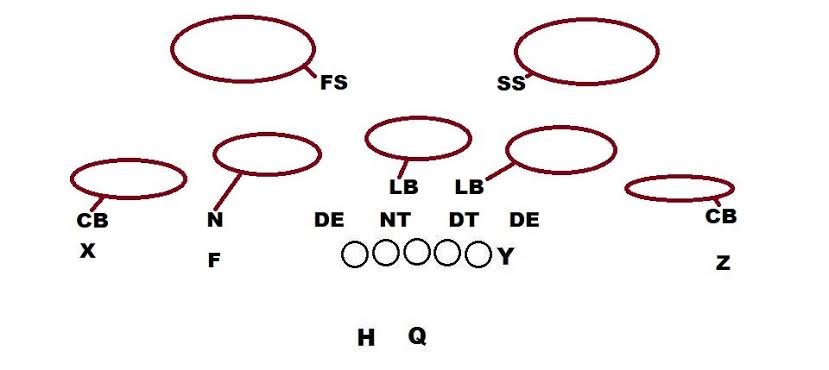
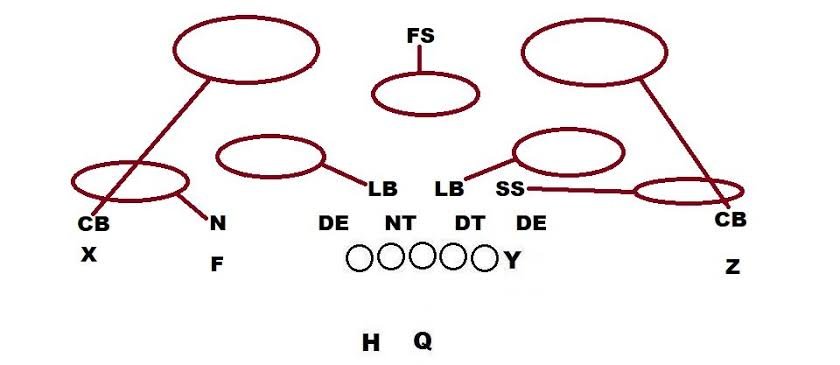
Take reading a defense for example. The two diagrams above are both cover 2 defenses, but the alignment of the defenders is totally different in each case. The second diagram shows cover 2 ‘invert’, getting its name from the responsibilities of the safeties and cornerbacks being inverted. Pre-snap, Cover 2 invert has the middle of the field is ‘closed’ as there is a safety occupying the deep middle of the field. For the most part, this tells a quarterback that the defense is likely in a cover 1 or cover 3 defense, since cover 2 and 4 are run with the middle of the field open, and cover 0 has no deep safety help at all. But post-snap, that middle field safety rotates down to the intermediate middle, and the cornerbacks bail out to cover the deep halves.
The quarterback, in his ~2.5 seconds, must recognise that disguise and progress through his reads accordingly. If he hoped to attack the seams with the idea that it was a cover 3 defense, and didn’t diagnose the disguised cover 2, then he may well throw straight into a bailing deep half cornerback and turn the ball over. And this isn’t just the case for cover 2. There are hundreds of different variations of different coverages, all with different pre and post-snap looks. The quarterback must be aware of where they’re weak and how a defense might try and trick him… in ~2.5 seconds.
At the same time as they are figuring out how they’re being tricked, QBs must also understand the progressions or targets of whichever passing concept they have called. Pure progression plays will have a quarterback run through progressions regardless of which defense is called, and as they cycle through they just throw to whoever is open.
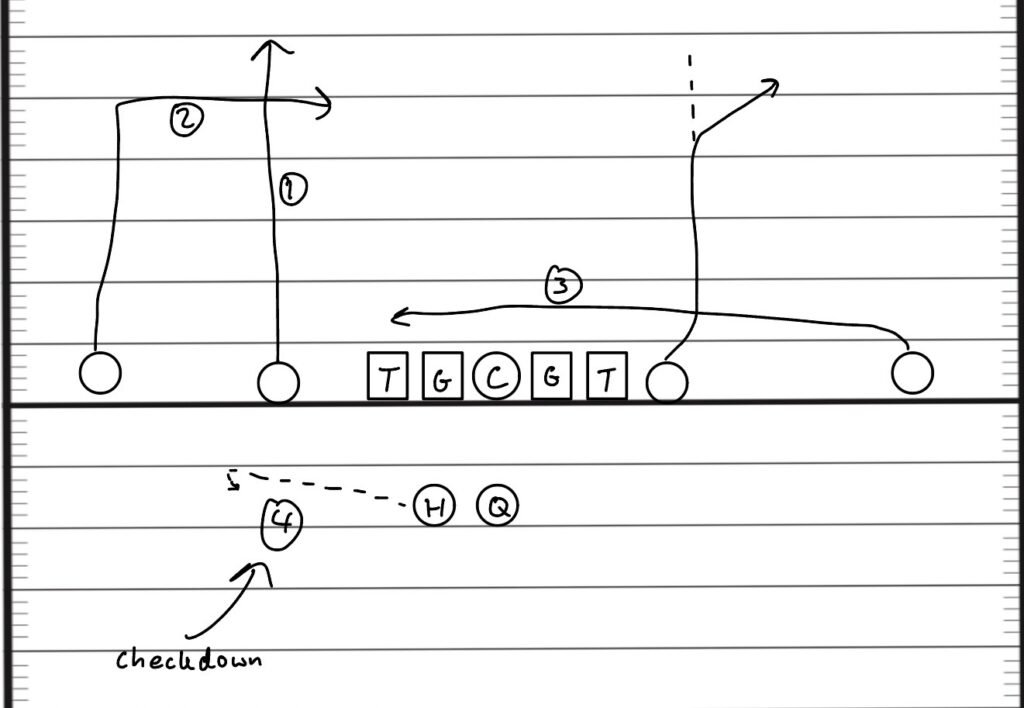
An example of a progression read play would be Dagger. Here, the quarterback simply reads 1, to 2, to 3, and down to 4 (if there is a checkdown route). This protects the quarterback from running a play designed to beat one coverage, just for them to be fooled by a post-snap rotation.
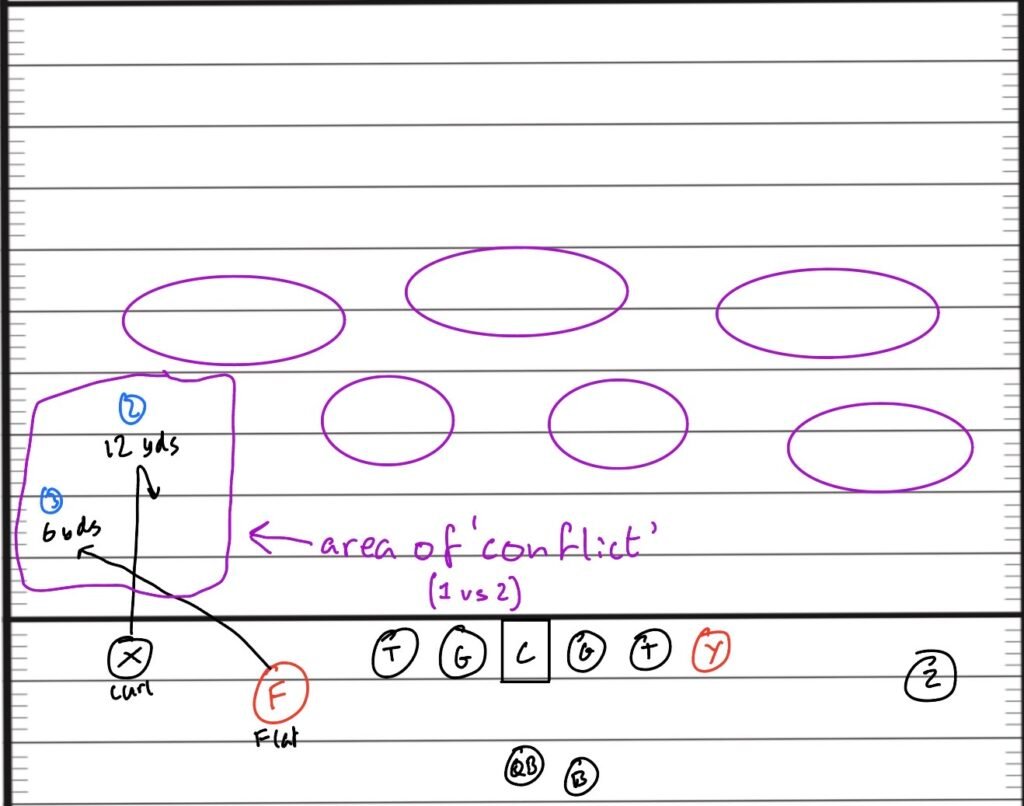
A pure concept play would something like Curl Flat. In concept plays, there is some defender or area of the field that the play is trying to exploit. In Curl Flat, the flat route accompanied by the curl flat above it puts the flat defender in both cover 3 and 4 defenses in conflict. They must choose which receiver to defend, and the quarterback just has to read that decision and throw wherever they aren’t. But if a defense calls man-to-man coverage instead, the concept is not nearly as effective since there is no conflict.
The important thing to understand here is that quarterbacks will likely have to remember the progressions and targets of the roughly 100 passing plays in their offensive playbook. They must then make sure that based on how they’ve read the defense pre and post-snap that they make the right read. If they make a mental mistake, they might just turn the ball over. And quarterbacks that turn the ball over don’t win or have very long careers (unless you’re Eli Manning of course). Just ask Ryan Leaf or JaMarcus Russell.
Now, even if you become proficient at reading defensive rotations, understand how those defenders are leveraged, and know your playbook back to front, you still have grown men motivated by the potential to make millions of dollars trying to throw you on the ground as often as they can. And defensive coordinators know how to generate the best opportunities for their players to do that. In the NFL season opener last night, on a 3rd and 7 play, Seattle Seahawks cornerback Devon Witherspoon came in free on a surprise corner blitz which totally blew up the play and led to Drake Maye just throwing the ball out of play and ending the Patriots drive. This was a surprise in the most literal sense of the word as there was no indication that Witherspoon was coming on that play. This cut Maye’s time to throw from the typical ~2.5 seconds to about a second – and he could only use that second to throw the ball away.
But following the theme of this story, the job is still not finished. The play could be fully understood, the defense correctly diagnosed, the pass protection set, and the concept called perfectly exploits a disguised defensive shift; but the QB still has to deliver the pass with pinpoint accuracy on time. Just a couple inches or half a second could determine whether the ball ends up in their team’s hands, or going the other way. Those margins could be the difference between being a starting quarterback, and being out of the league. And you can only get to the point at which you find that out once you have overcome the mental obstacles that I’ve outlined throughout.
So, as a quarterback, even if you do everything right, the odds are still stacked against you. And you just have to do the best you can with the worst hand at the table – no other player on the field is asked to as much with as little margin for error.
In a nice way, we’ve come back to where I started. Sure, no other player on the football field is asked to do as much as the quarterback with as little margin for error. But I’m confident that no one in any sport is asked to do as much as the quarterback with as little margin for error. And even if you disagree and think there’s a group of athletes that have it harder, it’s fairly clear that the job description for the QB is absolutely ridiculous.


Is Reece James being phased out of football?