


When I saw that Bam Adebayo had 67 points with 9 minutes to go in the 4th quarter of a random game in the middle of March, I couldn’t believe my eyes. So, before we discuss what the fallout from his eventual 83 point outburst was, we should really take a second to give him his flowers.

By scoring 83, he beat out Kobe Bryant’s 81 point game back in 2006 for the second highest individual scoring game in NBA history (behind only Wilt Chamberlain’s infamous 100 point game). There have been many games in NBA history in which whole teams have failed to score 83 points. So, Bam achieving that number on his own is truly incredible. His 36 made free throws and 20 made field-goals mean that Bam saw the ball go in the rim an astonishing 56 times during the game. That alone doesn’t sound real, and is a testament to not only his ability and focus, but also his determination to continue scoring. After scoring 50 or even 60, he’d already done something astounding, but to continue pushing up to 83 is peak determination.
What interested me the most about this historic performance was the the reaction that many fans and even other players had to it. Kobe’s 81 point game is one of the most beloved performances of many basketball fans and players, so someone beating it was bound to be a big talking point. However, the severity of the disapproval has been truly worrying.
It seems as though a lot of people are looking for any reason to discredit Bam Adebayo’s performance. Some are upset that he shot 46 free throws. Some are upset that he played 42 minutes. Some are upset that he shot 22 three-pointers. Some are apparently upset that he did it against the Washington Wizards? And some just don’t like Bam.
Now whilst all of these issues have plausible explanations, and in some cases solid reasoning, the fact that this many people have such a massive problem with someone achieving something incredible is alarming. Is it insecurity on the part of some of the ex-players? Maybe. Is it an attempt from fans to downplay his achievement because it makes them feel a little better about their lives? Maybe. Is it really a commitment to ‘ethical hoops’ that makes people uncomfortable with the ‘shot-chucking’ and garbage-time minutes that Bam played? Maybe.
Regardless of the reasons for why people are hating on Bam for what he did, the fact that people are hating on him is exactly what is wrong with not only sports culture, but our culture as a whole. When someone does something as impressive as scoring 83 points in an NBA game, there shouldn’t be any negativity. In theory, and if we were all objective, selfless people, we would only say incredible things about the incredible feat Bam pulled off. But in sports, we aren’t objective and selfless, we’re biased and self-centered. We think about if we like a player’s style of play, their personality, and if they pose a threat to someone else that we like a little more. We also seem to have a fixation on downplaying things that we could likely never achieve ourselves, maybe to make us feel a little better about that improbability.
That is a massive problem in general. But it’s an even bigger problem when it becomes a prominent narrative in a space as big as sports media. A space that influences so many people so heavily. As much as I advocate for people not being influenced by influencers, and instead thinking for themselves, when Houston Rockets head coach Ime Oduka says Bam ‘only made 6 threes, he shot 40 free throws, and did it against the Washington Wizards’, his position as a prominent figure in the sport rubs off on people, and gives them the impression that what Bam did is not that impressive. He’s wrong for that.
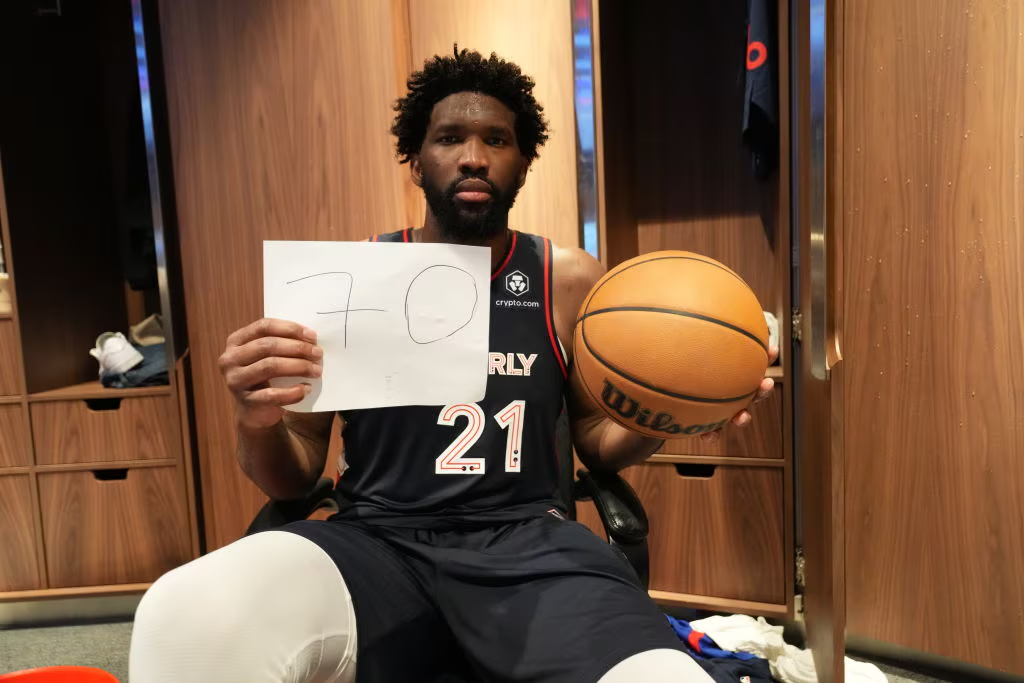
When Kelly Oubre Jr. mentions that Joel Embiid’s 70-point game was ‘more efficient’, it makes it seem as though it is fair to downplay Bam’s game when really, all Oubre is saying is that he prefers Embiid’s game to Bam’s (possibly because Embiid is his teammate).
This culture of comparisons and downplaying others is a symptom of something a bit bigger. For the most part, people in society don’t seem to be happy with others being successful unless they are successful themselves. If your favourite player plays really well, you’re more likely to appreciate the great game had by someone else. But if your favourite player has a bad showing, you’re more likely to look down upon someone else’s great game to protect your affinity to your favourite player.
That’s what often happens in sports, but it also happens on a personal level. You feel better talking about someone else’s good day if you’ve had one yourself. You’re happy to hear about the productive day your friend had but only if you’ve had one yourself. If you’ve had a bad or slow day, you’re not as receptive to hearing about someone else’s good or productive day. You might compare to some good days that you have had to make yourself feel less bad. You might downplay their achievement so that they don’t feel so far away from you. Regardless of the reasons why, we, for the most part, don’t seem to be able to objectively appreciate the good things that other people do unless we’ve done good things ourselves.
And when you translate that to sports, you get people being unable to see how utterly incredible it was that Bam Adebayo scored 83 points in an NBA game. They think about how Kobe Bryant was a better player than Bam to defend their affinity Kobe in light of Bam passing his record. They think of the time they scored 35 free throws in a row while shooting around to downplay Bam’s performance and close the distance between them and his achievement. They think of the time they shot lights out in a local league game to make themselves feel like they could score 83 just in case they were given all the opportunities Bam had.
It’s easy to understand how it happens, it’s a constant in human social interaction and is often referred to as ‘social comparison theory’. The idea that we judge how well we’re doing, and even how well others are doing by comparing the relevant action or idea to someone else’s.
However, it doesn’t mean that it is right, and it is definitely worth noting and conversing about. So, to refer to the title of this article, Bam Adebayo’s 83-point game told us that our basic human tendencies have pretty devastating implications on the way that we consume sports. They often prevent us from giving flowers to those who really deserve them. They make us bitter and selfish. But most importantly, they make us subjective rather than objective, and that is, especially in cases like Bam’s, not good for sports.
So, in short, Bam Adebayo’s 83-point game told us that sports culture, just like culture on the whole, is poisoned by our selfish desire to compare.





Is Reece James being phased out of football?