
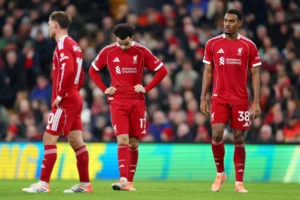

I simply don’t know how to describe my experience watching Liverpool this season. Some games I think they’re impossibly boring. But sometimes I see beautiful tactical emphases and patterns of play that I can only imagine were spitting images of whatever was drawn up at training that week.
It has been a rollercoaster, but for someone who is both a fan of the club, and also a diehard fan of the sport, it’s worth doing a deep-ish dive.
A season of literal ups and downs.
It would be ridiculous to talk about this season’s Liverpool team without looking at how unbelievable their runs of games have been all year. They started the season winning their first 7 in a row. With 6 of them being won with goals after the 83rd minute and all but one being won by just 1 goal. As much as the results were perfect back then, you could sense that the team was far more vulnerable than they were last season.
In fact, I wrote back in September that the way that Liverpool were grinding out results was going to leave them susceptible to losing in the late parts of games, where things get a lot more random. And just 5 days after writing that article, Liverpool went on to lose 2-1 to Crystal Palace, with the winning goal coming in the 97th minute of play. To go along with that, they have either lost the lead or game altogether in the late stages of games against Chelsea (2-1 loss), Manchester United (2-1 loss), and Leeds United (3-3 draw). It’s truly no surprise that you could describe this season as one of ups and downs when almost every game has still been up for grabs in the last 10 minutes. Those losses and poor performances headlined a run in which there was considerable pressure on both the team, but even more so on Arne Slot.
But to go along with the weirdly successful start, and miserable next 10 or so games, Liverpool are currently unbeaten in their last 8 games, a period that stretches to the back end of November. And to be completely honest, not much has been different in terms of the play on the pitch.
And to me, this randomness is a direct consequence of Liverpool not having as much control over proceedings as they once did. Ironically, they do lead the Premier League in average possession per game (61.2%), but they’re not using that possession to impose their will on games.
The best example I can think of is the recent 2-1 win against Wolves. After going 2-0 up just before half time, Liverpool entered the break in the kind of ascendancy that you dream of at kick-off. They had 76% of the possession, and surrendered only 0.06 xG (stats via FotMob), while generating 1.13 of their own. But the second half was unbelievably different. That possession haul dropped to 56%, they surrendered 1.01 xG, and only generated 0.42 themselves. It felt like whenever Wolves wanted the ball, they got the ball. Whether it was the rushed clearances, bad decisions in build-up, or the clear feeling of anxiety, every ounce of control over that game was lost. It was literally up to the football gods, and luckily Liverpool had done enough in the first half to hold on to the 3 points.
But this is the issue, the football gods are getting involved a little too often in their games. And I said this months ago – no one knows what’s going to happen in a game with Liverpool. They can beat Aston Villa 3-0, but lose 4-1 to PSV. They struggle to beat possibly the worst team in Premier League history in Wolves, but showed in the Champions League that they can beat teams like Real Madrid and Inter Milan. It’s incredible to watch. Well, maybe a little less if you’re a Liverpool fan like me actually.
The many many tactical changes
As someone who loves the intricacies of football, seeing just how much… stuff Liverpool have changed this season has been super interesting. And I say ‘stuff’ because it seems like sometimes there is no rhyme or reason behind some of the changes that have been made. It would be difficult to go through them all in this piece, but here are some of my favourites.
Florian Wirtz has is becoming Slot’s Phillipe Coutinho
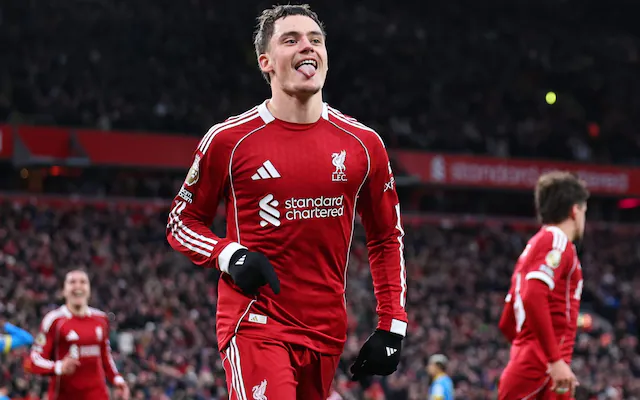
To begin the season, Florian Wirtz struggled in just about every way a midfielder can. He frequently had heavy touches, his incisive passes rarely found teammates, he lost a lot of duels, and couldn’t seem to pick the ball up in places that gave him real comfort.
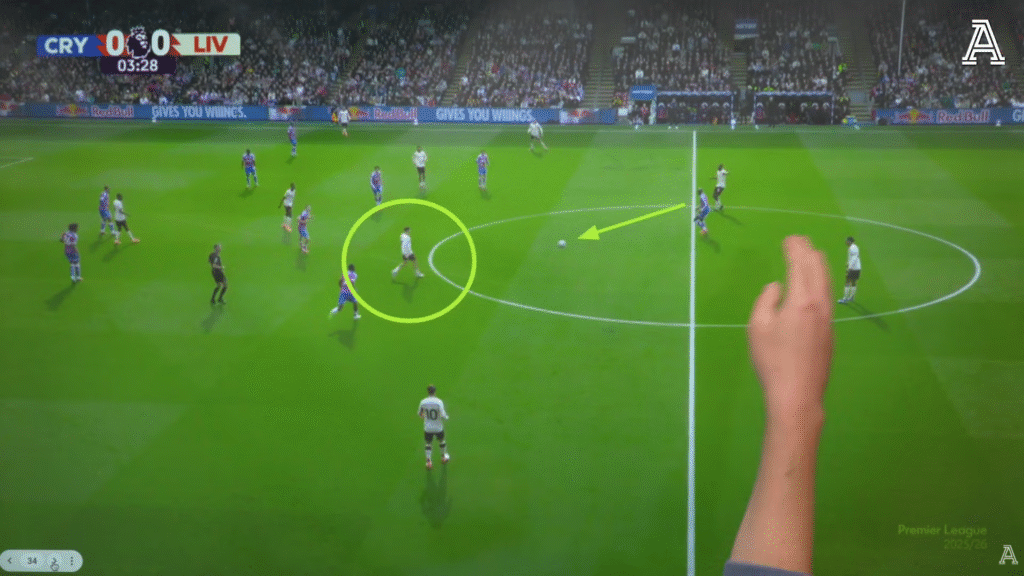
As JJ Bull said in a video for The Athletic on Wirtz/Liverpool back in October, he would routinely position himself so deep to pick up the ball in areas that he could progress play, that he never found himself at the tip of attacks to help score or assist goals.
That is undoubtably part of the reason that it took him so long to register his first Premier League goal and assist – which he achieved in back to back games against Spurs (assist) and Wolves (goal).
That goal and assist, however, came with Wirtz lined up as a pseudo left-winger. Instead of forcing him into a midfield 3 or even 4, Arne Slot has found a role that allows him to be alleviated of a lot of the responsibilities that were causing him problems at the start of the season. As a left-winger, Wirtz can worry less about his positioning, counter-pressing, and recovery runs. Instead, he has been primarily concerned with being a threat in the attacking third – which is what he was signed to be.
These are points about Wirtz that I made in a video on my own YouTube channel, that emphasised how limiting his defensive responsibilities will do a lot for the team, but more importantly, for Wirtz himself. After all, if you can make things better for the reigning German Player of the Year, you will likely make things better for your team.
What’s interesting about his new role is how much it differs from previous and current Liverpool wingers. He isn’t taking players on like Luis Diaz, Sadio Mane, or even newboy Rio Ngumoha. He isn’t cutting inside to recycle, cross, or shoot like Cody Gakpo. Florian Wirtz as a left-winger looks a lot like Philippe Coutinho under Jurgen Klopp. Although he hasn’t yet produced the same output that the Brazillian did, he looks well on his way.
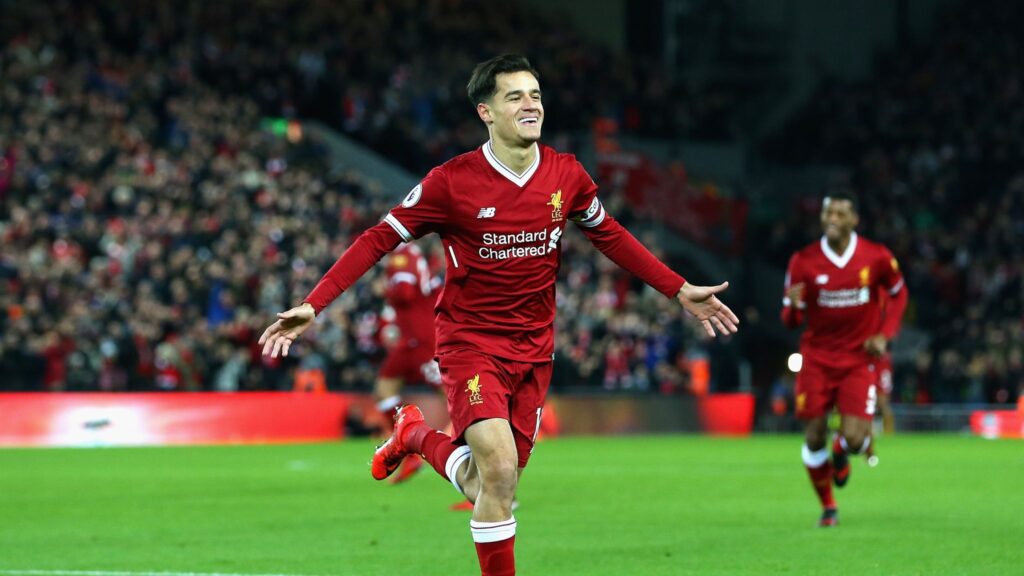
As a midfielder turned half-winger, Wirtz has tendencies to get involved in sharp, and swift interplay during build-up, but he is also given the license to take the type of risks that make him one of the most promising talents in world football. He doesn’t have to worry about losing the ball much anymore, and he is trying things that he simply didn’t have the confidence to try just a month ago.
Just like we saw Coutinho’s best moments when he was playing with positional freedom and bags of confidence, we might be seeing the beginning of that with Wirtz in a similar role.
Curtis Jones is becoming undroppable
Now I’m going to preface this section by admitting that while Florian Wirtz is my favourite player in world football, Curtis Jones might be the player I enjoy watching the most. And that doesn’t mean anything to my argument about him as a player, since believing so would be a fallacious argument (ad hominem to be specific), it just helps you understand why I felt so compelled to add it to this article.
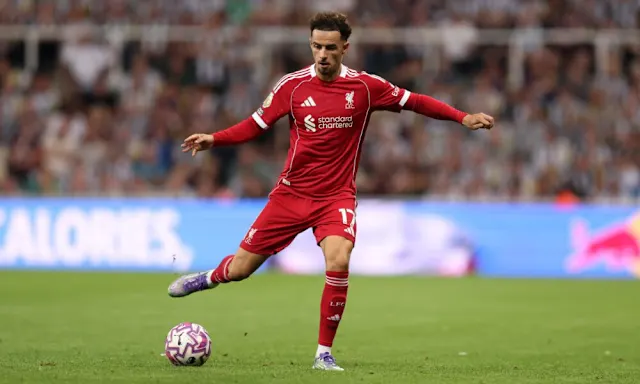
Over the last 6 games, of which Liverpool have won 4 and drawn 2, Curtis Jones has had an average rating of 7.583 (FotMob), a figure that is only beaten out by Ryan Gravenberch’s 8.05 amongst Liverpool’s midfielders in that same period.
And with Curtis Jones, you get something that sometimes stats and match ratings might miss – a sense of calmness. With Gravenberch you expect expansion and progressive dribbles, with Szoboszlai, you expect ball-striking, progressive passes, and goals, and with Alexis Mac Allister, you expect swift interplay, a desire to win the ball back, and overall polish. But with Curtis Jones, you get something different.
You get a player who is comfortable enough to perform 3 Cruyff turns in his own box each game, direct traffic in build-up, and put his teammates in the best positions for them to succeed. And sometimes, in a team with so so much quality, you need a player that will almost take a back seat and provide directions, as opposed to being behind the wheel themselves. That is what Curtis Jones does, and it’s why I’m not surprised by the uptick in results that we’ve seen during the 6 weeks in which he’s been a nailed-on starter.
Liverpool might be level matchers and not level setters
Out of the 27 games that Liverpool have played this season, there have only been 5 games in which the difference in the scoreline between the two teams has been greater than 2 goals. One was the seemingly freak 5-1 win over a very bad Frankfurt defense in the Champions League. Outside of that, the other 4 occasions have been heavy losses for the Reds. 3-0 to Manchester City, 3-0 to Crystal Palace (albeit with a very scaled back squad), 3-0 to Nottingham Forest, and 4-1 to PSV.
I’m oversimplifying slightly, but this means that in the remaining 22 games, there has been no real superiority between the teams in terms of the scoreline. Now sometimes this doesn’t mean too much because a 2-0 win, like the one at West Ham, can feature an overwhelming dominance that the scoreline just doesn’t reflect.
However, the lack of large wins and the presence of some very heavy losses tells me that Liverpool are not often the team setting a level that their opponents struggle to meet. More often than not, they raise their level to compete with teams like Inter (1-0 W), Arsenal (1-0 W), and Real Madrid (1-0 W). But they will also stoop down to the levels of teams like Leeds United (0-0 and 3-3 Ds), Nottingham Forest (0-3 L), Sunderland (1-1 D), and Brentford (3-2 L) allowing these lesser teams to steal points from them regularly.
Now logically, the only conclusion that I can draw is that Liverpool are capable of being an elite team, but they need elite opposition to bring that side of them out – otherwise they are too timid to show their teeth.
Where do they go from here?
I have to say that following Liverpool as a fan, and also a journalist this season has been a fantastic experience – simply because you have no idea what you’re going to see next from them. It could be a masterclass, it could be a disasterclass. In fact, it could be a first half masterclass, followed by a second half disasterclass like we just saw in the 2-1 win against Wolves.
We could see new signings like Florian Wirtz, blossom for 3 games, and then look just as lost as they were to begin the year. We could see Alexis Mac Allister take his starting spot back from Curtis Jones in the second half of the season, or we might see Arne Slot throw Szoboszlai at right-back again to get all the midfielders in. What I’m trying to get across is that with Liverpool we ‘could’ see absolutely anything, so trying to predict the future with this team, is likely harder than with any other team in the Premier League.



Are Liverpool trying to be like the Dodgers?