


So, the other day I was playing the new Fifa and I was testing out the 4-5-1 formation. For those unfamiliar with formations in European football; the 4-5-1 sets up with 4 defenders across the backline, 5 midfielders across the midfield line, and one lone forward.
And although I’ve played a lot of football in the midfield line of a 4-5-1 formation myself, I couldn’t help but realise these recurring patterns in how the unit of 5 worked to defend the middle of the field (with that middle moving with respect to where the ball is). And while Fifa isn’t the best representation of football, it did do a good job of spurring some thought about the formation outside of the game.
The reason these patterns were so weirdly apparent to me is likely due to how much American football and Madden I have watched and played recently. And it clicked, the middle 5 in the 4-5-1 is eerily similar to the underneath coverage in a Cover 2 defense.
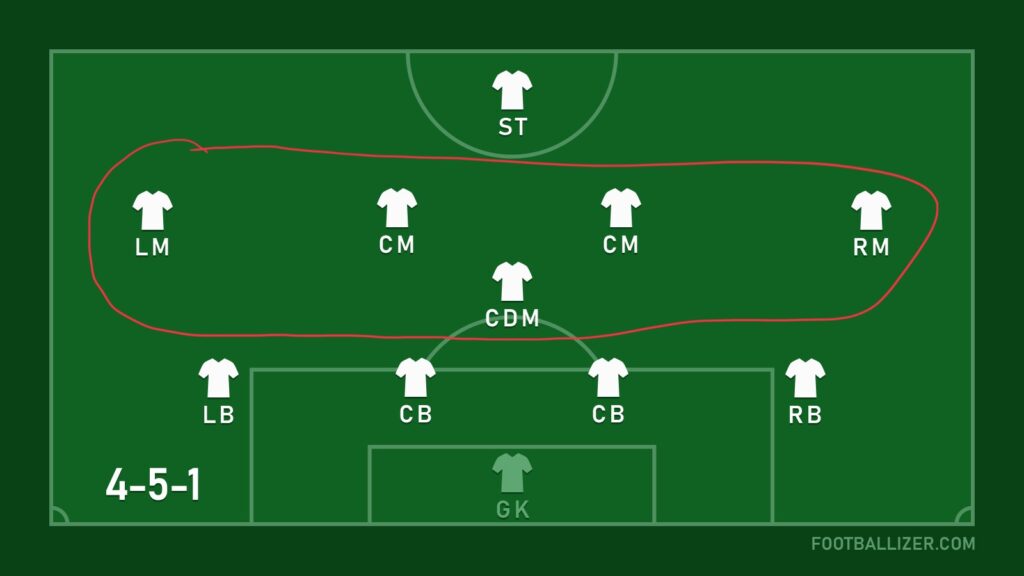
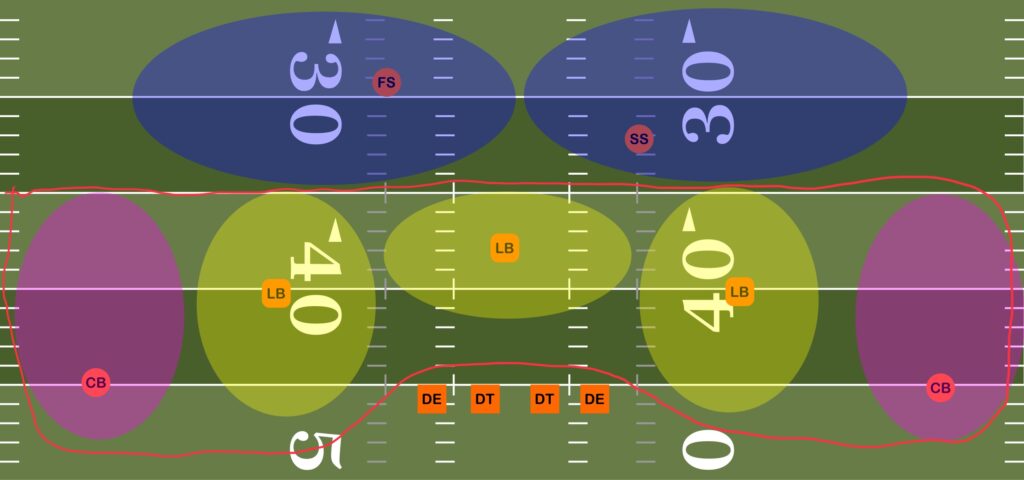
In both setups, there are five players who are tasked with blanketing the middle part of the field. If the ball or a player enters their zone, they are tasked with preventing the ballcarrier from carrying the ball further or preventing the player from receiving the ball in the first place.
Sure, there are some major differences with the two defenses overall, such as there being a 4-man pass rush in a traditional Cover 2 as opposed to the 1-man forward line in a 4-5-1 formation. Which is due to the fact that there is a line of scrimmage in American football that gives defenses close proximity to the ball – incentivising them to send more players to apply pressure. In European football, applying that much pressure is likely a death sentence. The ease at which professionals will play through and over teams means that teams will sacrifice the pressure for deep defenders (which explains why most European football formations have 4 or 5 defenders whereas NFL teams will routinely leave anywhere between 0 and 3 players deep).
And even more obviously, there being a goalkeeper on a European football team, that isn’t necessary on an American football team, means NFL teams have one extra player to utilise in whatever system they decide to run, a luxury that European football teams cannot afford.
And that made me think, how similar are the two sports on the whole? Is there a reason or rhyme to why they seem so similar in certain regards?
When you’re a schoolchild in Physical Education, you learn about the different types of sports. There are net/wall games like tennis and volleyball, striking and fielding games like baseball or cricket, but most important here, are invasion games like European and American football.
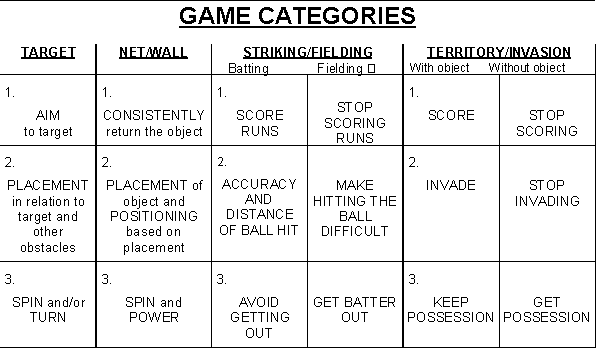
For these types of games, the objective is to invade the opposition’s space or area to score points/goals. So, naturally, you also have defend your area. This is where the overlap occurs, European and American football teams are both trying to defend a goal, and the way they go about it is partially shared across the sports.
In an invasion game, your ultimate aim might be the end-zone or opponent’s goal but you are usually best served by gradually working your way down the field until you get there. This will involve short passes, or runs that slowly move the playing field closer and closer to that ultimate goal. And teams know this. The Cover 2 defense (with its 5 underneath defenders) is best used when trying to stop short-medium routes over the middle of the field. The same can be said of the 4-5-1 in European football, it is best used when trying to take control of the middle of pitch.
But sometimes, a team playing an invasion game will take the risk of losing possesion and attack deep down the field. This is where teams will sacrifice some of that control over the middle.
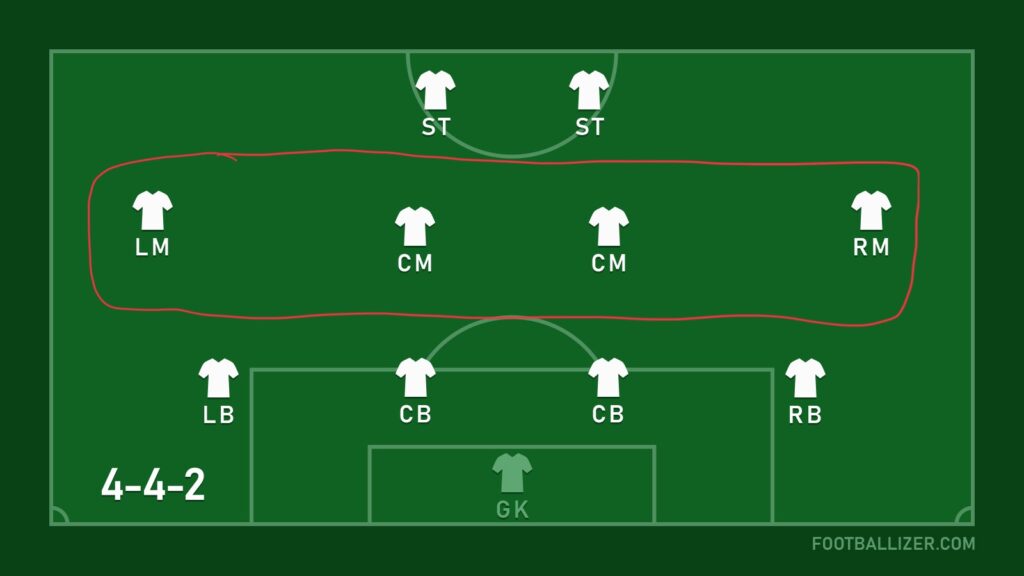
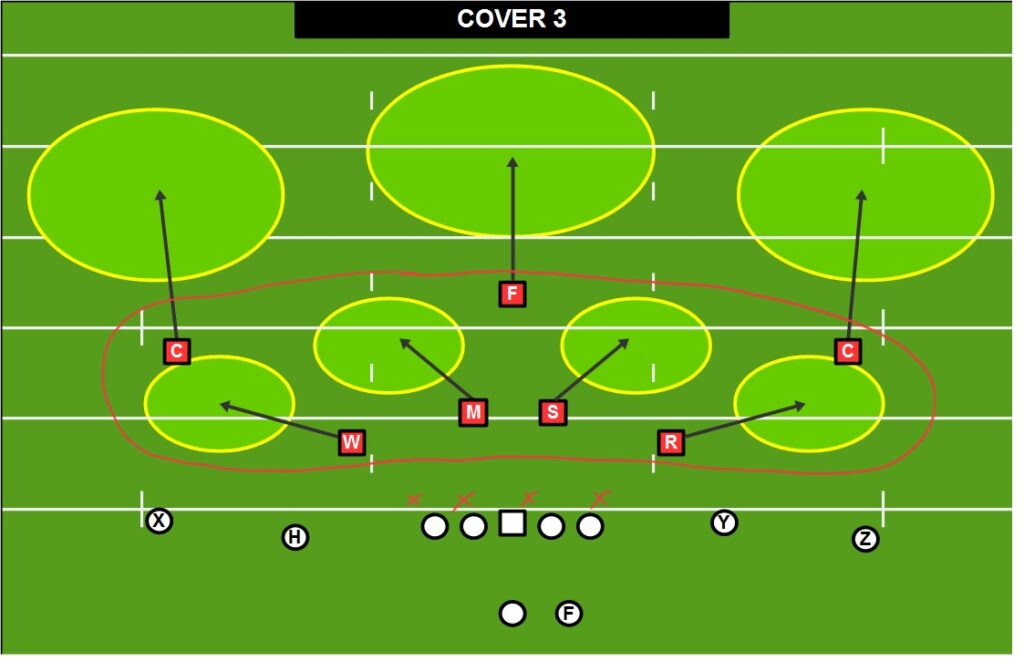
For a European football team, they may use a 4-4-2 formation, sacrificing a midfielder to add another forward to the pressing line. And for the American football team, they may switch to a Cover 3 defense, sacrificing an underneath defender for a deep one.
In the 4-4-2, the extra presser, in theory, makes the ball through and over a team more difficult since they will have less time to play those passes. So, even though there is more space in behind the forward line, the added pressure is supposed to mitigate that weakness.
As for the Cover 3 defense, there is no added pressure (in bases defenses) and the intermediate part of the field is simply sacrificed to better protect the deep parts of the field.
Whilst the reasons teams in each sport would switch from a 5-man middle to a 4-man middle might differ, the way they work together to defend the invasion of the opposing team is just like it was in the 5-man middle. Each player has an area of the intermediate part of the field that they are primarily responsible for and the unit works together to defend the entire area. Just now, each player goes from having 20% to 25% to cover.
Okay, now that I’ve had my fun making comparisons between two games that, at face value, seem so wildly different, it’s only right I get further into those differences and how they affect my ideas.
Firstly, European football players both attack and defend so their formation and subsequent positioning is designed to allow them to most effectively do both. Sometimes a 4-5-1 features a midfielder that is more responsible for attacking the opponent than he is concerned with defending his 20% of the middle. Sometimes, a midfielder will press a defender, which drags him out of his 20% and gives the remaining midfielders more defensive responsibility. What I’m trying to say is that the continuous nature of European football means that the formations and positional decisions that players make are fluid. Sometimes, they will switch assignments, sometimes they will be too concerned with attacking to also be able to defend, sometimes they will take up new positions in response to what their opponents are doing.
With American football, the defense only plays defense, and the offense only plays offense. When it is a team’s turn to attack, they send out a different set of 11 players than the 11 that just defended (unless you’re Travis Hunter playing offense and defense for the Jaguars of course). Furthermore, the players are only defending one play at a time, there is no continuity. They defend one play in one defensive shell and can be in a completely different one for the next play. This means that when a team calls Cover 2, the 5 underneath players play Cover 2 – that is their only job. They don’t switch assignments (traditionally), they don’t get ready to attack, they don’t adjust their responsibility based on what the opponent does (again traditionally). I say traditionally, because there are some man-match principles in some cover 2 defenses, but they fall outside the scope of this article so I’ll leave them out. Generally, if a team calls Cover 2 and their opponents call a play that beats it, they just have to live with it.
So, there are some very big differences in the way players in each 5-man middle will think about their defensive assignments which will obviously impact the way they go about defending that intermediate area of the field. However, the similarities are still clear.
In invasion games, you must defend the invasions of your opponents, and in many scenarios, the intermediate areas are commonly targeted as teams make gradual charges towards their ultimate goal. So, on the most fundamental level, when a team trots out a 5-man middle that is responsible for defending that intermediate area, regardless of the sport, they will work as a unit to prevent their opponents from making that charge successful in very similar ways. From ultimate frisbee, to American football, to European football, or field hockey – the principles are relatively similar and thus, defense in those sports is subtly very similar too.





Are Liverpool trying to be like the Dodgers?